
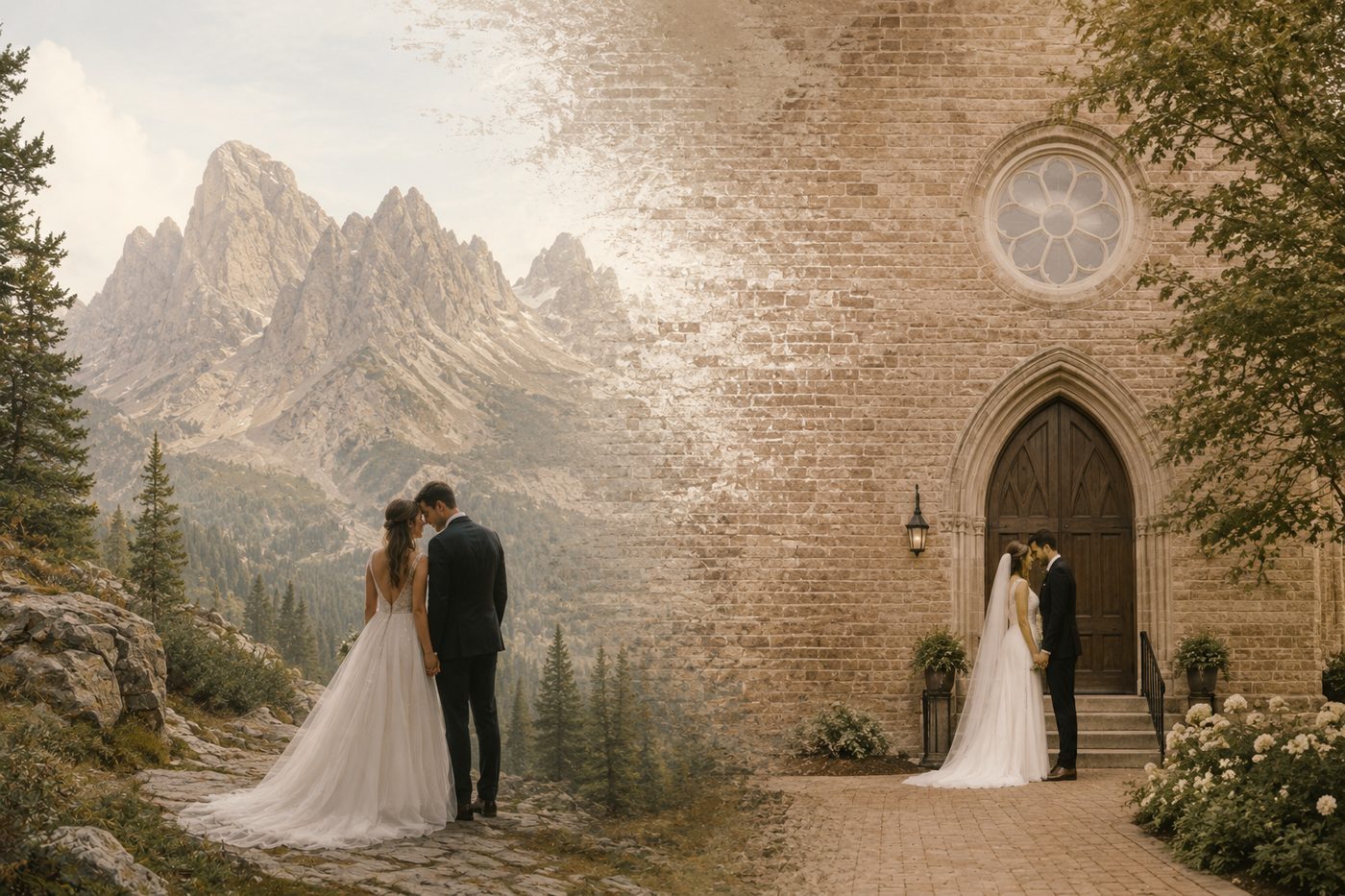
I have stood at the edge of two destination weddings, and each time I came home carrying the same feeling, one I did not see coming. My nephew married in the Bahamas. My best friend married in Hawaii. Different islands, different people, and yet what stayed with me afterward was never the ceremony or the view or even the food. It was a deep, unhurried peace. The world seemed to slow all the way down. No rushing from one obligation to the next, no receiving line a hundred people long, no watching the couple get pulled in a dozen directions at once. Just warm air, the sound of the water, and the people who had traveled to be there, present in a way you almost never get at a wedding back home. More than once, I caught myself thinking, this is what it is supposed to feel like.
It is exactly the kind of wedding my boyfriend and I want for ourselves. When we get married, it will be in the Rocky Mountains, with only our immediate family, far from the noise and close to the people who matter most.
Still, a destination wedding is not the right answer for everyone, and a wedding close to home holds a beauty all its own. Picture two mornings. In the first, you are getting ready in a room you have known your whole life, the parking lot outside filling slowly with every face from your past. In the second, you are barefoot on warm sand, the hush of the ocean standing in for the string quartet, surrounded by only the people who crossed an ocean to be there. Both are weddings. Both are beautiful. And the space between them holds the question nearly every couple has to answer sooner or later: which story do you want to tell?
I am a travel advisor. I have spent my life in the kinds of places people dream of marrying in, and a long career running large events inside them. I cannot tell you which of those two mornings belongs to you, because that answer is deeply personal. What I can do is walk you honestly through how each one tends to unfold, including the parts the glossy photos never show, so you can feel your way toward the choice that fits the life the two of you are actually building. Let me take you through it.
The Guest List Decides Almost Everything
Every one of these decisions traces back to a single one, the guest list, and it quietly writes the entire day, more than the venue and more than the dress. It is also where a destination wedding shows its hand first. When people have to board a plane and book a room to be there, the ones who come are, almost by definition, the ones who truly want to be. You are not performing for a ballroom of distant cousins and your parents' coworkers. You are surrounded by your actual people, and because they traveled to reach you, you are not handed three rushed minutes with each of them in a receiving line. You get whole unhurried days. A wedding at home offers the opposite gift, and for some couples that is exactly the right one: the wide open door, every face from every chapter of your life in a single room, no one left off the list. Neither is wrong. One gathers everyone for an afternoon. The other gathers your closest circle for an adventure. The honest question is which one you will be glad you chose when you look back in twenty years.
Where the Money Actually Goes
That smaller guest list does something to the budget that catches almost everyone off guard. People assume a destination wedding is the lavish splurge and the hometown wedding the sensible, frugal choice. Usually it runs the other way, and the math is almost embarrassingly simple. According to The Knot's 2026 study, the average wedding at home now costs around thirty four thousand dollars, and nothing drives that number harder than the headcount. Trim the list and you trim nearly everything along with it, fewer plates, fewer chairs, fewer centerpieces, fewer of it all. Plenty of couples marry at an all inclusive resort in Mexico or the Caribbean for a fraction of that, with the ceremony, the reception, and much of the stay folded into one clean package. There is a structural twist in your favor too. A wedding at home asks you to pay for every guest, while a destination wedding asks your guests to cover their own travel and room, the way they would for any vacation they chose to take. None of it is guaranteed. A grand affair abroad can still outspend a simple one at home. But dollar for dollar, you are buying something different, not three hundred people fed for four hours, but days of real time with the people you love most.
One Day, or a Whole Chapter
And that time is the part I wish every couple understood before they decided. A wedding at home, for all its months of planning, comes down in the end to a single day. A beautiful one, but a fast one, gone in a blur of photographs and handshakes before you have quite caught up to it. A destination wedding refuses to be that brief. It unfolds like a chapter rather than a scene. Your people arrive early and linger late, and the celebration spills across welcome dinners and slow beach mornings and long goodbyes that nobody wants to hurry. You are not squeezing the most important day of your life into six frantic hours. You are living inside it for the better part of a week. And that, far more than the sand or the sunset, is what stayed with me at my nephew's wedding and again at my best friend's. Not the view. The time.
And Then, the Honeymoon
There is one last gift a destination wedding hands you, and it arrives the very moment the celebration ends. You are already there. The flights are behind you, the bags are unpacked, and when the final guest heads for the airport, your honeymoon simply begins, with no second trip to plan and no cab to catch. Marry in Tulum and drift down the coast. Marry in Maui and never check out. A destination wedding folds the trip of a lifetime and the first days of your marriage into one unbroken stretch, which is either wildly romantic or wildly practical, depending on which of you is asked. Usually it is both.
How to Know Which One Is Yours
So how do you actually choose? Sit quietly with a few honest questions. Do you need everyone you love in the room, or only the people who would move mountains to be there? Does one enormous day light you up, or does a slow string of them sound more like you and the person you are marrying? Would you rather pour your budget into the guest list, or into the experience? There are no wrong answers here. There is only the version that sounds like the two of you when you say it out loud. And if you talk it all the way through and still cannot land on one... that is exactly where I come in.
Why Hire Me
Let me be straight with you about what I am, and what I am not. I am not a wedding planner with twenty years of bouquets behind me, and I would never pretend to be. What I am is the person who has spent a career doing the quiet, unglamorous, make or break work that a destination wedding is actually built on. For years I planned and ran large conferences, the kind that packed anywhere from thirteen hundred to five thousand people into a single hotel, and I owned the parts that decide whether an event glides or quietly comes apart. I negotiated the hotel contracts. I locked in the room blocks and the room rates. I sat across the table from sales teams and worked out the setup, the food and beverage, the flow of the schedule, and the hundred small details nobody notices until one of them goes sideways. A destination wedding is, at its heart, that exact kind of event. Better flowers, far more emotion, and a guest list that will not fill a ballroom.
Here is what all of that means for you. After a career spent handling contracts, room blocks, and the thousand logistics a large event lives or dies by, I know how to plan a celebration far from home so it runs smoothly, and how to see the details coming long before they ever land on you. And I treat every wedding like it is the only one on my calendar, because to me, yours is. You bring the love, the vision, and the guest list. I handle the contracts, the room blocks, the travel, and the logistics, and I stay in your corner from the first daydream to the last goodbye. That is the whole point of putting it in my hands. On the most important day of your life, you get to be fully present with the people you love, instead of fielding questions and chasing down loose ends.
And if, after weighing it all, you choose to marry close to home? You still have me. A hometown wedding carries its own pile of logistics, and that pile happens to be exactly the kind I love. I can book the flights and hold the hotel rooms for every family member and friend traveling in to celebrate with you. I can help you track down the right restaurant and narrow a long list of venues down to the one, for the ceremony, the reception, the rehearsal dinner, and everything in between. Destination or down the road, my job does not change. I carry the details, and you get to be fully present at your own wedding.
Destination Wedding Questions, Answered
Are destination weddings cheaper than traditional weddings?
Often, yes. The average traditional US wedding runs around thirty four thousand dollars, and because cost climbs with guest count, a smaller destination guest list usually spends far less. An all inclusive resort wedding can cost a fraction of a big wedding at home, though a lavish celebration abroad can still run higher. It comes down to the choices you make.
Who pays for guests to travel to a destination wedding?
Guests almost always cover their own flights and hotel, the same way they would for any vacation. That is part of why a destination wedding can cost the couple less, and part of why the guest list tends to be smaller and more committed.
How many guests usually come to a destination wedding?
Fewer than a wedding at home. Traditional weddings average well over a hundred guests, while destination weddings tend to land somewhere between thirty and eighty, since travel naturally narrows the list to the people who most want to be there.
How far in advance should you plan a destination wedding?
Give yourself more runway than a hometown wedding. Nine to twelve months is a comfortable window, long enough to lock in the resort, hold a room block for your guests, and send save the dates early enough for people to plan their travel.
Do you need a travel advisor for a destination wedding?
You do not have to have one, but a destination wedding is a large event staged far from home, with contracts, room blocks, and logistics in a place you cannot drive over to check on. A travel advisor handles all of that, coordinates your guests' travel, and is your person on the ground when something needs sorting. It is the difference between planning a wedding and enjoying one.